Saturday, March 31, 2012

*Sigh* No Forest

In a move that should surprise no one, Canadian/Chinese forestry company Sino-Forest filed for bankruptcy in Canada yesterday. The timing of the filing shouldn't be a surprise either, since the company was due to deliver its 2011 audited financial statements and also unsurprisingly couldn't find an auditing firm willing to sign off on them.

Thus, the saga which began ten months ago when short-seller/analyst Carson Block put out a report stating that the company was a fraud, is winding down.

In the interim, we've seen a famed hedge fund manager (John Paulson) humbled, a kiwi billionaire (Richard Chandler) lose a $100 million+ bet and a committee of Sino-Forest's own directors spend $50 million to investigate itself, concluding in a nutshell that the trees exist, but they're not sure if the company owns them in any way.

We've also seen a criminal probe by the Canadian authorities, which is likely to end in the conviction of no-one.

Lawsuits abound, including class-actions against the company (good luck with that), the former auditors (Ernst&Young), directors and executives. Not to be outdone, Sino-Forest is suing Mr. Block for $4 billion  dollars. As one internet poster put it "That will teach him to expose fraud".

The lesson here, children, is not that fraud doesn't pay, It's that you have to do it right.

Be sure to set up in impenetrable and incompatible jurisdictions. When you're exposed, deny, deny and then deny some more. Countersue your accusers and/or the authorities. Pay yourself millions to investigate yourself, giving time to put your person and your assets well out of reach of those greedy lawyers and their needy victim clients. Blame your boss or your subordinates.

Remember, the truth will not set your free. The opposite is much, much, more likely. /sarcasm

Tuesday, March 6, 2012

Stanford Bowled Out

It was three years in the making, but this morning in Houston a jury found Robert Allen Stanford guilty of 13 charges of conspiracy, obstruction and fraud, stemming from the operation of Antigua-based Stanford International Bank.

For a while there, I was wondering if "Sir Allen" was going to weasel his way out of this one, the same way his scam escaped detection for over two decades: hiding behind lawyers and other highly compensated professionals. Just yesterday, it had been announced that the jury was split on some issues. Apparently, that was only splitting hairs. Like many, I followed the trial on twitter (great job by the Houston Chronicle and KUHT...still going on at #stanfordtrial). Some the defenses expert witnesses' declarations were to put it mildly:  "far away from conventional wisdom". It's amazing what a few hundred thousand dollars in professional fees can do to your technical knowledge base.

Luckily, the jury didn't pull an OJ, and took the evidence for what it was worth.
On the side of the prosecution they showed detailed confession by a co-conspirator plus a money trail backed by documental evidence. Stuff that you just can't make up.

On the side of the defense, a two pronged alternate theory: that CFO James Davis worked alone or that there wasn't really a fraud. They brought in experts to state that taking out $2 billion in loans from your own bank (fraud), not disclosing the fact (fraud squared) and flatly denying any loans to anyone (fraud cubed) was all Ok. What's more, everything would be made right again when the pieces of the Stanford empire were put together in a "consolidation" plan. As if consolidating several piles of crap would yield something other than a larger pile of crap.
They didn't address the shortfall in investment returns, which was what gave the whole scheme away ultimately. Anyway, the jury didn't buy it. Unfortunately, we taxpayers will still have to pay for those experts' "work".

Naturally, this is not the end of the Stanford saga. There are still the criminal trials of the Chief Investment Officer (Pendergest-Holt), the accountants (Lopez and Kuhnt) and the Antiguan regulator (King), in addition to the certain appeals for Stanford and perhaps others. It does seem that if there were others in on the scheme, they mostly likely will get away.

For those who were caught in this web and lost their money, the journey towards closure is far from over. A trial currently taking place pitting the SEC vs. the SIPC, may give relief to some or perhaps yield just another disappointment. In the meantime, the process of asset recovery in Antigua and the US, has been so far fruitful only to the legal scavengers, for whom time is money and delay is profit. For now, investors have only received frustration.

So Stanford now joins Madoff, Rothstein, Nadel, Pearlman and many others in the Ponzi Hall of Convicted Felons.

He did manage to beat one of the wire fraud charges, the one relating to the purchase of Super Bowl tickets for Antiguan Regulator Leroy King in 2006. That botched my plans for a blog title reading "Stanford Bowled for a Duck".

Cricket fans would get it.


Wednesday, February 15, 2012

Crowdfunding gets its game on

(My daughter Astrid brought this to my attention. I found it interesting and asked her to write a Post about it. Enjoy!).


On Wednesday, February 8th, 2012 at 8:52 pm, the gaming world and the world of publishing any kind of media tilted ever so slightly on its axis. The main culprits of this shift are a small California based video game developer known as Double Fine productions and almost 50,000 fans and gamers who banded together to make the change.

For those of you not familiar with the gaming world, game publishing is a risky and unwieldy beast. Games, especially big name mainstream titles, take a lot of money to make and most publishers would never want to back a project doesn’t have 100% certainty of paying back the funds they’ve dropped into it.

Right here is where Kickstarter steps in. For those of you who haven’t heard of it, Kickstarter is a webpage that brings creative projects out into the public eye and allows people to crowd-fund them. Projects range form comic books, to documentaries. The amounts requested vary small $1,000 projects to much larger projects up in the hundred thousand range. The projects don’t receive the funds until the goal has been met and once the project is complete, depending on how much you donated, you might get a sweet little bonus for helping them out. It’s a small, but useful set-up for creative people to be supported by the internet at large.

So when Double Fine Productions decided to ask for $400,000 in order to produce an old school point-and-click adventure game and a documentary about its creation, they didn’t expect much. Point-and-click adventure games are considered a ‘dead’ genre in the games industry. According to the industry, these games don’t sell, so in turn they don’t get funded or get made. At best, the company was hoping to barely reach their goal and be able to produce a game, realistically, they barely expected to make $2,000.

But the internet has a mind of its own and once word got out, things got off the ground in a very big way. Within 8 hours, the Double Fine Adventure project had reached its intended goal of $400,000. In 24, they’d climbed all the way up to $1,000,000. That’s one million going towards a game for a ‘dead’ genre, a genre the mainstream doesn’t care to even touch.

At the time of writing, there’s still almost a month left to continue to fund the project and once the money is assigned, Double Fine is looking at almost $1,800,000. And that number is still climbing.

Admittedly, a lot of the success of the project can be attributed to Double Fine’s impressive pedigree (Founder Tim Schaffer is a huge name in the point-and-click gaming world, and their staff is a veritable all-star lineup for this sort of project) and its loyal fan following (who are still waiting patiently for Psychonauts 2, if anyone out there is listening).

But despite that the impact of this on the gaming community, and any creative medium, is almost mind-boggling. Kickstarter had already been funding smaller independent projects, but this proves that it can be done at a much larger scale. It could open up a new avenue of pay-to-create media that would take a lot of gamble and guesswork out of a normally outrageously risky project. Double Fine proved that if there is an audience, funding can be found, and it changes the basic way we can think about something being a risk, or sellable, or viable, or anything. The internet is changing the world, my friends, and I like the way this looks.

Sunday, February 12, 2012

Reverse Combustible


FINRA has recently launched a probe into what they are calling yield chasing instruments, among which are derivative-linked CDs. 
Banks have been selling a lot of these products, which tend to be quite profitable for them. Here’s a short explanation of a popular product called “reverse-convertible”, “barrier” or “knockout bond”, so you can understand why these are popular with the banks.
The standard Reverse Convertible  product works something like this:
Joe, a 65 year old retiree. is looking to invest $1 million, but is unhappy with the yields offered on short term CDs and other similar products. So his banker or broker offers him a "reverse convertible", sporting a 10% yield over six monhs with stock XYZ as underlying and subject to certain conditions.  Joe is enticed by the yield and buys in. 
In six months, Joe expects to get his $1 million back plus $50.000 in interest. Those $50.000 are normally to be paid regardless of what happens to XYZ. 

The principal, however, is only guaranteed if certain conditions are met. In this hypothetical case, the condition is that XYZ, which is currently trading at $20, doesn’t trade 20% lower at any point in time during the 6 month period. That is, if XYZ trades at $16 or lower, even briefly  intraday, the “knockout” feature is activated and the instrument is no longer principal-protected.

Once the knockout feature is activated, it means that instead of Joe getting his $1 million back, he might get 50.000 shares of XYZ instead (its the banks option). 

Since XYZ is a nice company and Joe doesn’t think it will go down that much, he invests, thinking that the bank is dumb to give him such a great deal. Ten percent interest in these days of low yields is great, right? And in the worst case, he gets some shares in a great company like XYZ. 
Ah, but the bankers smile, because they have this covered. Here’s what they do:

They sell puts 6 months in the future at that $16 strike. Five hundred contracts, which should net them at least $1 each, possibly more. That’s $50.000 for those who are doing the math. That covers the interest that needs to be paid to Joe when his product matures in 6 months. So in case XYZ stock behaves nicely and Joe’s bet pays off, the bank doesn’t lose a cent. They also have $1 million to play around with for 6 months, so you can assume they make some interest on that, too. 
Of course, if XYZ tanks, Joe stands to lose some serious cash . Let’s say it goes down to $14.The bank will get its puts assigned buying 50.000 shares at $16 per share which they will give to Joe in exchange for his million dollars. Net profit for the bank: $200.000.

Net loss for Joe is $250.000: the $300.000 in lost market value for his shares of XYZ minus the $50.000 in interest he collects. 
If XYZ closes somewhere between $16 and $20, the bank can still make a tidy profit, if somewhere along the line XYZ traded under $16 triggering the knockout provision and allowing the bank to assign the shares to Joe at $20/sh. In this case, since the stock has settled above $16, the bank would buy the shares in the market and then “sell” them to good old Joe at the agreed upon $20, earning the difference.

Of course, if the stock trades higher, or never breaches the $16 limit, Joe simply collects his interest and the bank might make a small profit. But Joe now feels like a winner, and armed with his new "knowledge", you can be pretty sure he's going to try his luck again on one of these products. He'll probably lose one of these bets eventually, and even if he doesn't the bank is still making small profits on each sale. 
Naturally, there are numerous variations of the product, including with multiple strikes and underlying instruments. The underlying doesn’t have to be a stock, it could be an index, or a commodity. If the bank doesn’t have the product you want, if you have enough cash, they will build it for you. That’s how much they like these things, and after this explanation it should be clear why.
Of course, times are hard for yield-seeking investors and many opt for these products, given the dearth of interest-producing alternatives. And to make a little, you have to risk a little, right?
Perhaps, but the problem is that the investor is bearing all the risk here and reaping only a fraction of the potential reward. If he were to sell those puts himself, he could pocket the $50,000 premium and tell the bank to take a hike. Heck, he doesn't even need to put up the whole $1 million in collateral.
What’s more, his risk in XYZ stock would be lower since the puts are assigned at  $16 (as opposed to $20 in the RC) .
Ah, but selling naked puts is complicated and brokers and regulators (including entities like FINRA) feel that Joe, who isn’t all that sophisticated, shouldn’t be allowed to take on that risk. So its not something that fits with Joe's profile and if a broker puts him in that trade (the naked put) and it goes wrong, he (the broker) could be looking for trouble. 

They have little problem, however, with Joe buying a reverse convertible. “Go ahead Joe. Knock your self out with a knockout bond”. 

Thursday, November 17, 2011

In Jefferies we Trust.

With the Euro crisis as a backdrop, as opposed to the housing/mortgage crisis of 2008, this year's Lehman Brothers has been MF Global, a medium sized commodities broker-dealer, spun off from Man Group a few years ago and which had actually purchased the business from REFCO back in 2005.
REFCO, as many may remember was the subject of a famous meltdown of its own. 

MF Global's demise came reportedly due to large leveraged bets on European sovereign debt which didn't pan out.  That's tough for MF's stockholders and bondholders, who are probably looking at steep losses.
Here's the graph for MF's 6.25% 2016 bond, issued in August 2011, which basically fell off a cliff in two months.


Like Lehman, MF Global's debt was "investment grade" (Fitch, S&P and Moody's), right up until the nasty stuff hit the fan in late October. Of course, MF was just a triple B, as opposed to a Lehman's AA at the time of its collapse, so I guess we're getting better in the ratings biz. Off topic, this is why I really don't invest a whole lot in debt of financial companies. Very difficult to analyze and foresee these meltdowns. 

Still, if it were just the stock and bondholders losing, no biggie. The problem is that the issue is affecting customers also. When brokers go down, customers don't normally lose their money or securities, because these assets are (or should be) segregated and separated from the broker's own. It can be a hassle to get everything set up again at new broker/dealer, but competing firms are normally more than happy to bring those customers on board. Sure beats wining and dining them.

The problem with MF is that apparently those customer funds were not well segregated. There is a reported $600 million "missing" from customer accounts. Big problem. 
First off, this isn't supposed to happen. You'd figure that this was a lesson learned from the Madoff scandal (BLMIS was first and foremost, a broker-dealer). Second, this didn't happen with Lehman, where customers were taken over by Barclays and their assets were there. It didn't even happen with Stanford Financial's brokerage arm (other stuff happened there).
So, big black eye for regulators once again. Hopefully the money shows up, but this is kind of like with missing persons. After three weeks, the chances aren't good.

This leads us up to the old crisis equals opportunity adage and the title of this post: Jefferies (JEF). Jefferies is a mid-sized broker-dealer. Not a household name, but well known and regarded in the industry. While checking the company's Sec filings, an analyst at Egan-Jones noticed that the company was long European sovereign debt in an amount equal to close to 80% of JEF's equity and proceeded to downgrade. 
The company said "Whoa, wait a minute. We make markets in those bonds and we're short (as in we have to deliver to clients) pretty much the same amount." (they didn't actually say THAT, but that was the message). JEF even went as far detailing positions and showing how they could change their inventory levels if the wish too. In short, JEF pretty much did everything right to control the damage. (Frankly, if  you used this same yardstick, where does that leave every European bank?)

However, stock and bond traders have not been understanding and much less forgiving lately and JEF's securities have sold off sharply, opening up what appears to be an opportunity. On the very short end,
JEF's 7.75% 2012 bonds (due March 1) are trading below par, for what would look to be nice pickup for less than four months. On the other end, some of the longer dated maturities are yielding at or close to double digits. JEF is still "investment grade" (FWIW, I know).

While the selling could still get worse, I like the odds on this one and am willing (and have) put down some coins on JEF bonds. Drawing on the 2008 parallels, buying Morgan Stanley or Goldman Sachs bonds while Lehman went down in flames, proved to be an excellent investment. We'll see how this one goes. With 2012s, we'll know soon enough. For the long run, the broker-dealer business model is obviously "under review". Bear, Merrill, Lehman and now MF can't all be aberrations. For now, however, "In Jefferies we Trust". 


Monday, August 29, 2011

Sino Forest Epilogue


Since I already did two posts on Sino, might as well make it three and out.

Last Friday, the Ontario Securities Commission suspended trading in Sino Forest stock, alleging that the company may have defrauded investors by exaggerating its profits and assets.
Initially, the order also called for the resignation of the company's CEO Allan Chan and other officers and directors. That portion of the order was then excluded (apparently the OSC doesn't have such authority), but the CEO and several others resigned anyway.

This would appear to be the argument that ends the discussion concerning this case. But you never know, there are always dissenting opinions and conspiracy theorists.  This announcement followed a flurry of news which included a very strange second quarter earnings report in which the company's erst-while rock solid operating margins evaporated, a three-month delay of the "independent review"  and downgrades from the major ratings agencies.

Carson Block is looking like a champ. For his part, John Paulson took his lumps like a man. It was big loss for his fund, but he showed he could recognize when he was wrong.
I do feel for the analysts who came out to support the company. Lesson learned, hopefully. Don't trust everything they tell you, sometimes the numbers are simply a lie. Company officials are NOT your friends.

As for the bond angle, there is a bright spot. On Aug 17, Sino paid its 2011 bonds in full. So whoever took a flier on that trade I mentioned in my previous post, made out like a bandit. I wasn't that brave.

Sino stock may be suspended, but the bonds can be traded OTC, as far as I can make out.
My Bloomberg is indicating a 26 bid on the 2014's (the ones I luckily sold at 72). Ouch!


Wednesday, June 15, 2011

Battle Lines Drawn in the Forest


It’s been almost two weeks since Carson Block's Muddy Waters report on Sino-Forest accusing the company of fraud.

I’ve been following the case even though I no longer have stakes in the game. There has been an interesting back and forth going on in the comment section of this blog and on other message boards. So here’s another post so that discussion can continue.

A few comments on where I think things stand.

1. The MW report

Substance aside, the report is poorly written. It’s self-serving. (Example: “Were Muddy Waters not to have come along, it is likely that this fraud could have continued for a few more years and billions of dollars more” – is this really necessary?). That lowers its value.

There’s information that is irrelevant to the company’s current situation. For example does some deal gone bad in 1994-96 have any bearing on the company’s value today? Probably not, it’s only there to establish a “pattern” of deceit. Lumping all this together in the report is confusing.

But the main elements of the fraud theory are there. The con itself: inflating profits and assets. The mechanism of that fraud: the use of opaque and undisclosed “authorized intermediaries” to fabricate transactions and profits, instead of selling directly (which would leave a paper trail). Finally, the cover up: a convoluted corporate structure to distract the auditors and manipulating the valuation process of its forests.

That’s MW’s theory. It’s not outlandish and certainly we’ve seen bolder scams go undetected for much longer. It could be wrong, of course, as is the case with every theory.

Now a lot of people are asking MW to “prove” their theory. That’s tremendously unfair. To do so, MW would have to have access to all of Sino-Forest’s records and books and be sure they were the “real” ones. That’s not going to happen.
They also can’t ascertain completely the scale of the scam, for the same reason. It could be that MW’s right and billions in assets are missing, or it could be more (or less).
The report says as much (“…without the aid of law enforcement, we will never really know how much money is there or where it went.”). You can’t fault them for that either.

What MW did was look at the evidence and put the pieces together for their theory (feathers, waddle, beak…hmmm).

Mr Block is being “made the villian” by those on the other side of the trade, which again, in my opinion, is unfair. Among other things there is a line of thought, that regardless of the outcome of investigations, Sino-Forest has been “mortally wounded” by his allegations.

Now, frankly the whole idea that you can “destroy” a company by spreading “false” rumors or information is hogwash. If the information turns out to be incorrect, then the company was what it said it was, and the markets will value it accordingly. If the allegations are true, a fraud has been exposed (hard to see the downside in that!). Even financial institutions, which are deemed to be more sensitive to “breaks in trust”, usually bounce back quickly once the air has cleared.
Sino-Forest’s stock has tanked. But lets be clear, a stock price does not a company make. Certainly not in the short run.

2. Company Rebuttal

After initially ignoring the allegations, the company took steps to address the situation. To look into the allegations they appointed an independent committee. That committee is only independent in the sense that it is comprised of “independent” (i.e. not working for the company) board members, but hardly “independent” in a third party sense, since those directors are probably still liable if fraud is present (self-incrimination, anyone?). The committee will be “assisted” by PriceWaterhouseCoopers, which is a good idea since using Ernst & Young, the company’s auditors, who also may be looking at some hot water, would hardly be independent enough.

Still, it’s important that PwC produce and sign off on any report for it to have any kind of credibility. Statements by the company or documents produced by the company without any third party independent (really independent) verification are automatically suspect.
The report is expected to take at least three months to complete.

The company also made some documents and information available to analysts and the public, but kept secret about others, such as its customers’ names and the location of its forests. That’s ok. They have no obligation to disclose this information to analysts or anyone else. When regulators and auditors come knocking, however, that’s a different story.

3. Others Chime in (or not)

The analyst at RBC Capital Markets, Paul Quinn, came out Friday (June 10th) with a very favorable opinion (Outperform – Evidence mounting in Sino’s Favour). Another analyst Richard Kelertas at Dundee (Canadian Firm, recently acquired by Scotiabank) called the MW report “a pile of crap” and was quite adamant in his support of the company (“we believe in the company, we trust the company). Of course, these guys have their reputation at stake since they have been following and recommending the stock for years. Since 2004 in Kelertas’ case and RBC has had an outperform on the stock since May 2009. Both firms reportedly did underwriting for Sino in its 2009 stock offering.

But they are not the only ones who did business with Sino. Credit Suisse, Merrill, Morgan Stanley and others were bookrunners on Sino bond and stock deals. So you can’t really use that as a rationale for the analysts’ positions. No, these guys truly believe what the company is telling them. I can relate. When I worked as an analyst there were some companies I followed for up to ten years and weren’t followed by anyone else. The execs knew me and I knew them. They’d show me the installations, tell me anecdotes and give me certain information that would never be “on the record”. Friends? Maybe. There was a certain empathy. The work’s easier when it’s not confrontational. But let there be no doubt about it, they would lie to my face if that’s what was their interest. And they did. After you get duped a few times, you learn to be a little less trusting and keep some distance.

Other analysts have been somewhat more skeptical. Annisa Lee, an analyst at Nomura Securities had put out a skeptical report already several months ago, well before the MW report. (and was reportedly cut off at today’s conference call). Morgan Stanley’s Vivien Gui also released a note (which didn’t get much press from what I see), which was called “my unanswered questions” and spotlighted doubts about the company’s scale, the location of its forests and the business model.

Then there is the enigmatic presence of Paulson with his large position. He is obviously attentive to what is going on, and reportedly has been supportive of the company. Unfortunately, he is “trapped” in a sense. Here’s why: my first impression was that Paulson should get his hooks in the committee and in the investigative process, to better assess where he stood. Ah, but by doing so, he would become an “insider” with the legal implications that that entails and thereby freeze his position. So, aside from laying blind bets in either direction, Paulson doesn’t really have any option but to wait.

At this point, the only ones who really know the situation are the company insiders. That is probably only a handful of execs. If there is fraud, the outside directors are probably clueless. (I’ve been on boards, the information you get is distilled more than a good scotch whisky). Ernst & Young, the company’s auditors, should know by now if they have been duped. You can bet that the first thing they did when this broke was to call in the Sino audit team and go over every sampling and every piece of independent verification that may be missing or suspicious. If something important got past them before, they now know what it was. Unfortunately since E&Y’s nuts are in the boiler, they won’t utter a word until they have checked and re-checked EVERYTHING. Don’t expect them to talk anytime soon. But they know…already.

4 The Bond Angle

Sino’s stock hit a new low today, but since I like to blog about fixed income and there aren’t a lot of bond blogs out there, I thought I’d chime in on some interesting movements in Sino’s bonds.

The 2014 bonds which my clients held (and the 2017s which they didn’t) have stabilized in the 60-70% range since their initial fall. One could interpret that as players assessing the best case scenario (no fraud full recovery) and the worst (partial recovery even if stock goes to zero) and looking for some middle ground.

2014 Bonds


The 2011 bonds, however, have rebounded sharply from a low in the 60% range to a recent price of around 90%. There would appear to be another dynamic weighing in this case. These bonds are due Aug 17 and there is only $87 million outstanding. Therefore, even if investigations finally reveal that Sino is a fraud, there’s a good chance these bonds could be paid before the results of those inquiries come to light. A play on the lack of expedience of the due diligence, if you will.

2011 Bonds


I’m not recommending it, but there’s is an alternative for Sino bulls to simply going long the stock, if you want to take it.

That’s where the Forest stands (or doesn’t) at this time. The other comment thread was getting too long, so please continue that fine discussion here. Go at it, just keep it civil.

Monday, June 6, 2011

Bitten by a Chinese Duck


Sometimes you see a duck for what it is. Sometimes you take it for what it tells you it is.

The story of the week and perhaps the year is Sino-Forest. This is a Canadian-listed stock, but the company has forestry operations in the Peoples Republic of China.

Last Thursday, a research group called “Muddy Waters” put out a 39-page report on the company, stating in no uncertain terms that the company was a fraud. The company also has no qualms in saying that they are short the stock, and stand to gain financially if their allegations prove true.
Here is their website. You can download the report. Muddy Waters

This case got my attention for an obvious reason: I have stakes in the game. For disclosure purposes, a few of my clients owned some Sino-Forest bonds (10.25% 2014s). Bonds are rated BB by S&P, which makes them junk, but really good quality junk (two steps away from investment grade).

I went back over my notes to see why we bought these bonds back in 2009. Actually we didn’t buy these in particular, but received them in exchange for a shorter maturity paper. Anyway, at the time it looked like a good deal. The company had a very strong balance sheet including a great amount of cash, plus solid and consistent earnings. Those earnings are what struck me as the most positive, because I used to work for a paper company and I know a little about the industry. It’s a tough industry to make money in consistently. But Sino-Forest did and with very strong margins, so more power to them. Financials were audited by Ernst and Young, a big North American firm, so despite being a Canadian Firm born from a "reverse takeover, I thought it was ok. So I laid some coins down for my clients. Not a large bet, by any means. We always diversify a lot. Because stuff happens.

So now this report comes out. The stock plunged (although today it’s on the rebound). Bonds plunged. I downloaded the report and went over it on the weekend. I won’t lie and say I understand every detail. But there is a lot there. Mainly, an explanation of why those profit margins were so generous (they’re false!). Plus there are details about why certain representations that the company makes about its operations, such as size of the plantations, volume of sales, etc. are not realistic. It’s a very complete report.

The company is out today in full denial, offering details about their assets, including the original titles to their plantations. Questions have been raised about the authors of the report and their motivations.

After reading the report and looking over my notes, I fully expected to not being able to unload my clients’ bonds this morning. But lo and behold and bless the market makers souls, there was a market for them this morning, and I managed to unload them at 72%. Facing a possible total wipeout of the investment, this was a windfall for me and my clients. I am very satisfied. Of course, I could have held on and waited for explanations from the company or some sort of recovery in the case of bankruptcy. I preferred to accept that potential "duck bite".

There’s good reasons to give credence to the Muddy Waters report and I’ll give a few. I’ve been sort of in these guys shoes, so I can relate.

  1. These guys are not hiding.

This is not a random anonymous blog or post on a message board. Serious time and money was put into this report and the research to make it happen. Please, let's focus on the “what” and not the “who”. When I was being questioned about that bank report back in 2009, the reporters seemed to be more interested in me than what my report was implying.

The analysts at Muddy Waters have a lot to lose if they are wrong. They face fines, jail time, etc. They are totally in the open on this. They also can't just go and cover their shorts now that they are on the record. They have more than money on the line. They are sure, very sure.

  1. It’s a murky business.

“If it’s so profitable, why isn’t everyone doing it”. There are few competitors in the business, but Sino-Forest is the largest by far. Another company China-Forestry, turned out to be (surprise) a fraud. That said, if the business were so good, there'd be more competition and margins would drop at some point. Hasn't happened (according to the company).

  1. Too good to be true.
Ah. Those profit margins. Yes, there is great demand for materials in China, and I’d assume that’s true for wood chips. But if your margins are this big, it has to be that you worked your forest for several years (grew/planted). But most of Sino’s forests were recently acquired. You can’t have you cake and eat it too. Either you worked the forest and are entitled to those large margins (the time factor, if you will) or you didn’t and the margins should be lower. You shouldn't be able to make this kind of money by just "flipping" a forest.

  1. The Cash, the Cash!
One of the things that drew me to Sino-Forest bonds can also be a great litmus test. The cash. There is supposedly over a billion dollars in cash on the balance sheet. If Sino’s profits are false, that money is going to be missing somewhere. It’s either going to be in the value of the forests or in the cash balances (or both). Of the two, the cash is the easiest to check. If the cash isn’t there, we will know its all a lie. (Have these guys provide certified bank statements? I'd need to see those, ipso facto).

  1. There is more than what is said.
Although the Muddy Waters report is extensive, it probably doesn't contain ALL of the analysts’ suspicions and red flags. That’s usually the case. You only put down on paper enough to drive your point and what has the best documental support. The research is much more extensive and probably includes a ton of anecdotal information which is not in the reports because you can’t really put down things that don’t “seem” or “feel” right or for which the evidence isn’t totally conclusive. Again, I can relate. That whole picture, however, is what allows them to be comfortable with their conclusions.

Of course, I don’t know anything for sure, since I didn’t do the work. You never know for sure. Analyzing from the outside is difficult, because you don’t have access to all the information that goes into putting out the company’s financials. You can’t really go asking the company for access either, as in “would you mind if I checked your books for fraud?”

Nobody likes to accuse anyone else of wrongdoing, even in the face of overwhelming evidence, for many reasons. It’s mean and most good people don’t like to appear being nasty or not giving the “benefit of the doubt” to the offender.

So here’s the question that I ask when a straight one way or another answer is required: “If your loved one’s life depended on your correct (not politically correct) answer, what would you say?”
With that on the line (which fortunately it is not), I’d lean towards calling Sino-Forest a Canadian/Hong Kong duck. If so, it will set a new standard for Asian Fusion fraud cuisine. We shall know soon enough.
This one bit me. Ouch.

Sunday, April 17, 2011

From Russia with Bonds

All investors have their favorite themes or "guilty pleasures". In my case, it's Russian bonds. Despite a troubled past and lots of questions about the future, I seem to feel at ease laying down cash on Russian names and enjoy the pickup over counterparts from other parts of the more "developed" world.

This affinity was only reaffirmed during the credit crunch of 2008-2009. When other countries were scraping for answers and cowering from creditors, the Russians showed some pride and put their reserves where their cojones were. Here's the graph:


During 2008, Russia went through about 40% of its international reserves. And while the financial press was portraying that as a weakness, it was quite the contrary. Russia was telling its local entities and companies: "look, if you need dollars to pay off your international creditors, come and get them". That's
kind of what international reserves are for, after all. They certainly gained the respect of this bond junkie.

The yield nowadays are nowhere near what they were doing the crisis, but I still feel comfortable with Russian bonds and will indulge in my "guilty pleasure" quite often.

For example, in the telecom space, instead of AT&T, Verizon (US) or Vodaphone, I'll take some Vimpelcom or Mobile Telesystems, thank you. With a nice pickup in yield, to boot. (Russians are more cellphone-maniacs than any other country, BTW).

In the energy realm, instead of thinking BP, Exxon or Chevron, how about some Gazprom, which is half owned by the Russian government anyway? Or Lukoil or TNK-BP?

Want something more exotic or risky? How about Alrosa (Diamonds) or Evraz (steel).

Here's a few individual bonds by these issuers.


Finally, here's an excellent clip portraying the history of the soviet union, to the music of Tetris.
Enjoy!


Sunday, January 30, 2011

REG S'ed


A couple of months ago, my wife came into the office to look for some files and thought I’d strike up a little conversation.

“Honey, did you know that Jordan is coming out with some bonds?”

I knew she’d be interested since we had visited Jordan in December 2009 and enjoyed the country very much.

“I’d like to buy some” she replied, even though I hadn’t told here what the terms were (not really exciting by the way).

“Sorry, but you can’t” I answered. “It’s REG S”.

It’s usually not a good idea to tell my wife she can’t do something, because she’ll just want to do it more. I knew I had to explain. (So here is kind of what I told her.

What happens is that in order to avoid going through the lengthy, complicated, bureaucratic and unpredictable process of registering a bond with the US SEC, many issuers will do what they call a private placement. They do it under REG S, basically promising that they won’t market or sell the bond to US Persons (citizens and legal residents). So the SEC leaves them alone.

“So I can’t buy it because I’m a US Citizen?” she said.

“Yep”

“That’s not fair” (you knew that was coming). “This is supposed to be the land of freedom” (and the capital of capitalism, I might add).

“Can I never buy these bonds?”

After a year you supposedly can, but good luck finding them or someone willing to sell them to you. Buying in an initial offering is normally a good deal also; the bonds routinely will trade a bit higher right after they’re issued. Sometimes the issuer will register the bonds with the SEC and make them available for trade on US markets, but they don’t have to.

“What about US companies? I can buy their bonds, right?”

No, not really. A lot of those, probably most, are REG S also. Even US companies figured out that it’s a lot easier to go that route and avoid dealing with the SEC.

I added that big US financial institutions could get in on most of these deals, even if my wife couldn’t, through a rule called 144A, which allowed “Qualified Institutional Buyers” or QIBs (not to be confused with Squibs, which are sons and daughters of magical parents who have no magical powers of their own), to participate in private placements also. So my wife needed not feel bad for Goldman Sachs or Morgan Stanley. They weren’t being left out.

By now my wife was very upset, she could do without buying Kingdom of Jordan 2015’s, but she did not like the to see her choices conditioned. In the world of investing, she was a second-class citizen, just for being a US citizen.

“I don’t understand. Why would the SEC do something that discriminates against US citizens?”

They do it to protect you. God forbid that Jordan or Dell Computer or someone else file their forms without all the right disclaimers, provisions and explanations that you are never going to read anyway.

“I’m really sorry I can’t give you a better reason.” I said as she left.

Of course, REG S, is just another example of regulatory patchwork, enacted in the 1990s to deal with exceptions and which ultimately became a rule. Along with security laws dating from the 1930s, which regulate markets and procedures inherited from the 19th century and before, you could think that the whole system was due for revamping.
Maybe we could use something more atoned to a global marketplace where information flows almost instantaneously. Things have changed in the last century or so (you’d think).

Don’t hold your breath. The current system serves the financial industry well. Very well. The recent events concerning Goldman Sachs’ private equity investment in Facebook illustrate the point.

As you may recall, Goldman agreed to invest $500 million in Facebook, through an ad-hoc vehicle. Goldman’s clients would then be allowed to participate in that vehicle and hence invest indirectly in Facebook.

Sounds like something to “like”, right?

The SEC then decided they should look into this deal a bit closer and perhaps force open Facebook’s private “books”. Facebook wasn’t quite ready for that level of information sharing with the world, so Goldman said “REG S”, which translated means “SEC, bug off”.

Vampire Squids 1, Regulators 0. Regular investors: DNP. (Do Not Play).

(The photo is Vampyroteuthis infernalis or the vampire squid from hell. Unofficial mascot of Goldman Sachs).


Saturday, January 15, 2011

State of the Junk


Happy New Year to all. Two-thousand ten was a very good for junk bond investors like myself. Not as fantastic as 2009, but we’ll take this kind of performance any day of the week and twice on Sunday.

The FINRA-Bloomberg High Yield total return index was up 12.2%, for the year, on the heels of a 46% gain in 2009. Not bad.
There are numerous indices out there and this one just happens to be available and free. HERE


The equivalent Investment Grade index did quite well also, yielding 6.5%, even if it did give up some gains towards the end of the year.

For 2011 there are some things to look forward to and some issues to worry about.

Positive for junk: improving economies lowering default rates . Positive for bonds in general: rock-bottom short-term interest rates which continue to force investors to move up in risk to lock in yield.

On the worry side: Big Ben at the FED. Ben’s latest folly, called QE2, as in quantitative easing two or too (take your pick) is a fresh round of dollar printing from your favorite bearded guy.

Jon Stewart analyzed this to perfection last month, but here it is for those who missed it.

The Daily Show With Jon StewartMon - Thurs 11p / 10c
The Big Bank Theory
www.thedailyshow.com
Daily Show Full EpisodesPolitical Humor & Satire BlogThe Daily Show on Facebook


I know there is a lot of debate over QE2, but I come from the third world, where we have been lectured for decades by first-worlders ad-nauseum that we can’t do this crap and get away with it unscathed.

Now, el Central Banker Numero Uno del Mundo is telling us that he can. Color me skeptical. This is going to come back and bite us and bond investors need to be aware.

When? Not Yet. How? Now sure. Stay tuned.

For now, it looks like us junk collectors will be fine in 2011, although it will be hard to keep up with the equity markets (so don’t try!). After that, it could be plan B time.

As for the photo: a cute little squid of the genus Stoloteuthis from the Indian Ocean.

Wednesday, October 27, 2010

Betting with Paulson


At times, investing in the gaming industry can be a gamble (/corny opening line). Not that it really has to be that way. Like any addiction, gaming produces quite stable cash flows once the business is up and running and a customer base and a location has been established.

The threats are there, of course, with the expansion of licenses from revenue-hungry governments and the ominous Internet. Still, “if you build it, they will come” has worked relatively well in the past, so who are we to question its future applicability.

That said, gaming is a place where high yield thrives, since, not unlike gamblers, casino operators love to “double down” with plenty of leverage.

Where there’s leverage, there’s “credits” (as the pundits like to call bonds these days) and opportunities for bond investors (somehow credit investors doesn’t sound right) to throw some chips into the fray.

Start with MGM Resorts International, which owns a good chunk of the Las Vegas Strip (Bellagio, Mandalay Bay, Monte Carlo, Luxor, Grand, etc.) plus casinos and resorts around the rest of the world. Lots of property with a ton of debt, and booking substantial losses. Still, it’s a name I like, since the cash flow is good, and the company has shown financial agility. They have sold property to raise cash and recently announced they would issue new stock to the market. That’s always good for bond investors. In addition, Hedge fund manager John Paulson picked up a 9%+ equity stake earlier this year. Not fresh cash, but it’s always reassuring to have a guy like Paulson below you in the capital structure.

For MGM bonds, there are a number of choices, ranging from senior secured (the least risky in case of default) or the subordinated, which may not fare well in such a case. I listed a few on the table below. Personally, I like the subordinated 2013’s, because you might as well go “all in” if you think bankruptcy is looking like a long shot. But in any case, all these bonds have rallied over the last year and the easy money is over.


Second up is Harrah’s Entertainment, which is a behemoth like MGM, only larger and with less concentration in Las Vegas and more property in Atlantic City (not a good thing). Harrah’s was taken private in 2006 by private equity firms TPG and Apollo, which then proceeded to load it up with debt. That’s standard procedure in these cases. It’s also standard procedure for these takeover specialists to screw over those debt holders if necessary and convenient. That’s also not a good thing. Still, as we stated above, this is a business that generates cash, apparently even in Tunica, Mississippi (where Harrahs has THREE casinos).

Still, it’s not enough to make a bondholder comfortable (not that we ever are). So, once again Paulson to the rescue. Paulson’s fund(s) recently picked up a nice chunk of Harrah’s debt (over $800 mm) and agreed to exchange it for equity. For bondholders that’s a good thing since it means some deleveraging, if not a whole lot. Harrah’s LT debt is close to $20 billion. The company is planning to go public with its shares shortly, and from the preliminary prospectus, it appears they will be selling an additional $575 million in shares to the public. That would be a good thing, since it would mean more deleveraging.

Still, count me as a bit skeptical on Harrah’s, and I’d prefer the secured bonds, which still are offering a very hefty yield. That would make it good for a couple of chips.


Here's a BST oldie to get you in the gamblin' mood.


Monday, June 28, 2010

Converting to Solar


Financial bubbles, not unlike supernovas, leave reminders of their explosions throughout the market Universe.
A bubble in alternative energy, and particularly Solar stocks grew quietly in 2006-2008 and burst pretty much in tandem with other bubbles such as the one in housing.

What were boom times have turned into dark times for solar companies, as competition is fierce and subsidies have been subsiding. Many of these companies are Chinese, so the Yuan’s recent revaluation has become a new concern.

But solar companies did take advantage of the demand for their stocks during the boom to raise capital and finance their activities, Solar panels may be shiny, but they don’t manufacture themselves.

During the brief boom, a very popular financing option for solar companies was issuing convertible bonds. Their stocks were on a tear, so the companies (wisely) decided to give up a bit of their potential stock upside for some cheap (low coupon) financing.

And so they did.

Fast-forward two years later and these convertibles are “busted”. That is, the market price of the underlying stock is so far away from the equivalent conversion price, that the convertible component of the bonds is practically worthless.

Nonetheless, they are still bonds, still pay a coupon and (fingers crossed) will repay principal at maturity. Now trading at discounts to par, the yields are enticing and these bonds have the added attraction in that a good portion of the total yield will come in the form of capital gains, which for many taxpayers implies a lower rate and pushing the taxable event a bit out into the future.

Here’s a table of some of the solar convertibles out there. Like always click to make it bigger.


With the exception of Trina Solar, whose convertible is in the money, the others are pretty much straight bonds now, so the main issue is whether or not they will be able to pay. In general, the prospects of that are not bad, since most of these companies are not excessively leveraged and could tap the markets for equity or new debt when time comes to roll over.
(As always do your own due diligence, and your mileage will vary).

Even Evergreen Solar, which appears to be the most vulnerable on the list, has a positive tangible equity in its books. Of course, ESLR has yet to make a profit, so keep that in mind.

My personal favorite is LDK Solar, which has been reporting profits and whose convertibles have a put provision that can shorten maturity by two years. Trading around 85% makes for a 26% yield in less than a year, if you exercise that put. Not very liquid, but if I managed to find some (and I did), they can’t be that scarce.

Energy Conversion Devices is another that looks “overlooked”. The company took a huge (non-cash) write-off recently, which affected the stock and general perception very unfavorably (some analysts consider their technology outdated). But there are believers and the company recently did some private debt/equity swaps with the convertibles (below the strike price, obviously). Although such an action is dilutive (and not great news) for stockholders, the more of those they do, they better chance bondholders have of collecting ultimately.

Of the others, JA Solar would seem to be the least risky and Suntech Power, the best value.

So, there you have it, a “green” alternative to my previous oily suggestions. May the daystar shine radiantly on your portfolios,

Sunday, June 13, 2010

Spill Bonds


It seems the whole planet has been watching the Gulf of Mexico oil spill. The world cup may provide a much-needed distraction from that unfolding disaster but in any event, analysts and traders are fast at work trying to find ways to make money in the oily turmoil, without appearing to be too oblivious to the plight of shrimp fishermen and seabirds.

Most of the work has centered on stocks, but like always, there is a bond angle to this also. Let’s “explore” and “drill down” to details.

First: the good guys, those trying to clean up this mess. Clean Harbors (CLH) is a name that comes to mind. Its stock is up over 20% since the spill. Its 2016 bonds, on the other hand, have traded flat. If you’re happy with a 7% yield on a BB- rated bond of a company whose prospects were fine and just got a lot better, there’s an idea for you. Clean and simple. The issue is a bit small ($300 mm), but it does trade (Reg S 144A only for now).

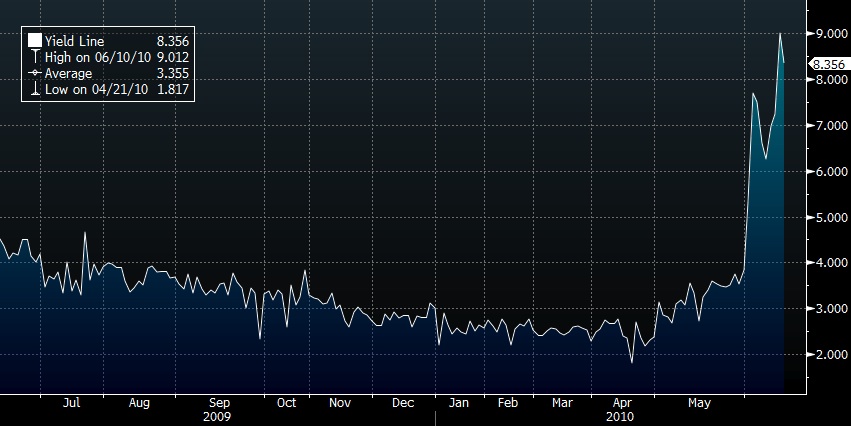
Now. the evil enviro-killers. BP jumps out first, of course, While much has been make of BPs stock slide, its bonds have sold off also. Here’s graph of the yield on BP’s 5.25% , 2013s as an example.


BP is still rated AA- by S&P, although we’d expect a downgrade at some point. In any case, the possibility that this spill will send BP into bankruptcy has to be extremely remote. The highest clean up cost estimate out there is $15 billion, which is huge amount of money. But BP can afford that, the company made $20 billion in profits last year.

At the bottom of this post there’s a list of oil spill bonds including some BP USD issues. BP also has issued bonds in Euros, Yens and Sterling, so the whole world can get clean up on what appears to be a temporary bargain.

BP may be the main target of the “spilling fields” disaster, but not the only one. Transocean (RIG) owns the Deepwater Horizon rig, which is leased to BP. Transocean will probably have a bill to pay in this fiasco too, but they too can afford it.

RIG bonds have been submerging also. Here is the yield on the 5.25%% 2013s. Quite a spike.


And there has been substantial “collateral damage also”. A company like Hornbeck Offshore (HOS), which doesn’t drill itself but operates supply vessels to the rigs has seen its stock and bonds hit. Several clients are reneging on their contracts alleging “force majeure” in the offshore drilling moratorium, but HOS isn’t buying that and is countersuing. The bonds have sold off and there is a nice buying opportunity, since the company’s balance sheet is still quite acceptable.

Then there are cases like McMoran Exploration (MMR) and Energy XXI (EXXI). These companies have operations on and offshore in the Gulf area, but the offshore ops are “shallow water”. Shallow water is a whole different animal when it comes to oil spill risk and the ban has been lifted for shallow water already.

Sunday, May 9, 2010

Yet Another Update on My Wife's Junk


Last year I blogged about the junk bond portfolio that my wife put together all by herself (mostly). LINK. I also ran an update on it later in the year. LINK.

This is what that portfolio looked like last time I updated: (click to enlarge)


A few things have happened since. First and foremost, everything went up. A lot. The portfolio gained 45% in 2009 and is up around 5% so far this year. Not that my wife was keeping count. She’s content to just clip coupons. I’m the one doing the counting.

Second there were corporate actions. Starwood Hotels (Sheraton) made a tender offer (accepted) and Jo-Ann Stores called its bonds.

In addition, the Alcoa and Seagate Bonds rose enough in price to trigger the “mortgage” sell signal. That signal basically states that if the bond pays less than our (tax-adjusted) mortgage rate, sell it and either buy something else or pay down the mortgage.

In any case, she decided not to pay down the mortgage, but rather to buy some more junk.
What to buy?

For starters, she selected SmithField Foods, a company I blogged about around Thanksgiving. That’s good because it means she actually reads my blog. When I mentioned that she already had two food companies in Dole and Chiquita, she said “What do Pineapples and Bananas have to do with Turkeys?” OK. Point Taken. Of course, coming from a vegetarian, who knows?

She did take my advice on her next purchase. I thought she could have an energy company in the portfolio, so I showed her several options. There are quite a few smaller oil and gas producers and refiners with bonds in the market at attractive yields. She chose Clayton Williams Energy, an oil and gas company with operations in New Mexico, Texas and Lousiana. Hopefully, for my sake, that well doesn’t come up dry.

Finally, she got motorized with her last two picks. First, Ford Motors, which has been doing much better lately and is benefiting from the troubles that Toyota is having. Ford bonds were huge winners last year, but still could have room to run.
Second, Avis-Budget Rent a Car, which is a highly leveraged situation, but my wife figures if they try harder they’ll pull through.

Here’s what the portfolio looks like now:
Click on the table to enlarge:


It’s a bit junkier, longer in duration and the overall yield is lower.

Only averaging about 7.56% now. But confronted with the alternatives: bank CDs at under 1% or taking her chances on the stock market, she says she’ll stick with her junk for now. She’s happy just to collect the interest. Market crashes? She's like "What me worry?"

That being the case, she should be able to sit tight and just clip coupons for another year and a half until her next bond matures. We’ll see what the world looks like then. Maybe it will be time to pay down the mortgage.

As for the photo. Yes, that is my wife. I married up, I know.

Thursday, April 22, 2010

Getting up to speed


I haven’t blogged for a while, so I thought we’d catch up on some things written about over the past year or so.

First, bonds in general. LINK. There is no doubt that corporate debt has been the asset star of the last year or so. While stocks have made their way back and are closing on their high-water marks, most bond portfolios and funds are hitting new highs.

The category is still very much in favor and there is some value still to be found. Don’t get too greedy and you’ll be ok. There are a lot of new issues coming to market both in the developed and emerging markets, so there is quite a bit to choose from. The big gains are over now, its coupon-clipping time.

As for more specific issues, our friend Borat must be happy. LINK. Kazakstan’s sovereign risk is now lower than many Eurozone countries. Not only Greece (duh), but Hungary , Portugal and almost Spain. The fact that Kazakh debt trades better than California’s was widely remarked in the press. LINK.

In Ukraine, things have calmed down. Elections were held in January/February and the pro-Russian candidate Victor Yankovych won a close second-round victory over Yulia Tymoshenko, despite her good looks. LINK. And so the “Orange Revolution” was reversed. Tension between Russia and Ukraine which contributed to the “gas war” between Gazprom and Naftogaz has come down dramatically and there are even talks of joint ventures. LINK. Russia has agreed to give Ukraine a price break on the gas it consumes, while Ukraine will extend Russia’s lease on its Black Sea Naval ports. LINK.
Naftogaz bonds, which defaulted briefly in October (swapped for new issue- LINK) are now trading at 108%. I remember an analyst stating that he “wouldn’t be surprised if the new Naftogaz bonds were trading above par in less than a year”. Oh wait, that was ME.
Isn’t it nice when neighbors get along?

As for corporate issuers: AIG and its subsidiaries are still current with their bonds all of which have rallied sharply. LINK. LINK. LINK. An important “turning point” was reached when airplane-leasing subsidiary ILFC returned to the bond market, thereby reducing the refinancing risk of its outstanding bonds. LINK.

Herrtz quietly dropped the suit against an analyst who had named the company as a possible bankruptcy candidate. They figured out it would only get them bad publicity. Took them a couple of months to figure that out. LINK.

Despite my skepticism, Kodak’s bonds and stock have rallied, as the company raises cash selling or licensing some patents and is trying to raise more by suing the likes of Apple and Research in Motion. I could have held on…oh well. LINK. LINK.

The price of Gold has stagnated, ruining a speculative gold trade I had set up, Sometimes investors DON”T go bananas. Especially when you expect them to. LINK.

Venezuelan bonds have rallied of late, but still yield much more than their credit rating would suggest. What good are the numbers if you can’t believe them? LINK.
Analysts are looking at a $1.5 billion bond maturity in August, as Central Bank reserves drop.

Blockbuster and Netflix continue their lopsided battle. The Hollywood studios have realized that Blockbuster’s survival is in their best interest. How much they will help keep Blockbuster away from bankruptcy remains to be seen. Anyway, the four trades proposed back in February are winners at this point. LINK. LINK.

Now that we’re up to date on these trailing issues, maybe we can move forward and I can get around to blogging more consistently.